Machine Learning Types and Algorithms
Prerequisite: Need for Machine Learning? (for better understanding)
Common terms used:
- Labelled data: It must consist of a set of data, an example would include all cats or dogs images in a folder, all the prices of the house based on size etc.
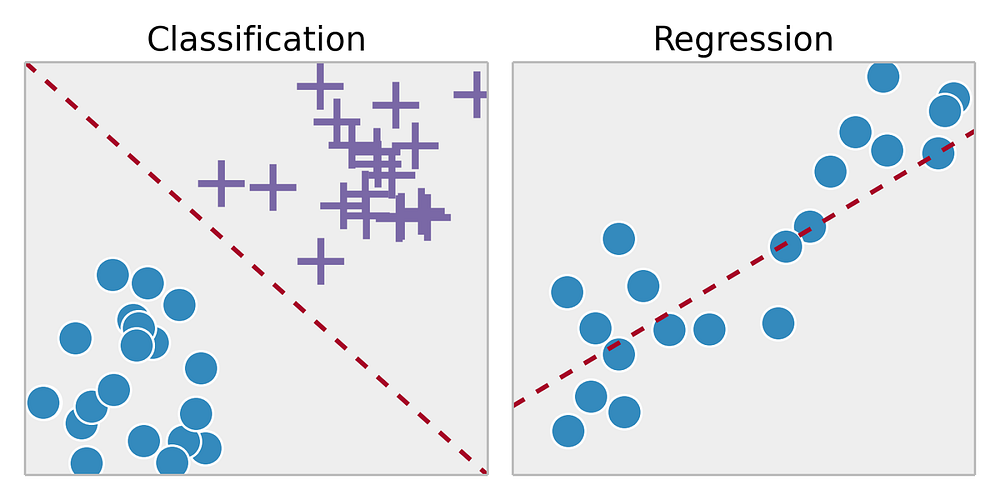
- Classification: Separating into groups having definite values Eg. 0 or 1, cat or dog or orange etc.
- Regression: Estimating the most probable values or relationship among variables. Eg. estimation of the price of the house based on size.
- Association: Discovering interesting relations between variables in large databases where the connection found is crucial.
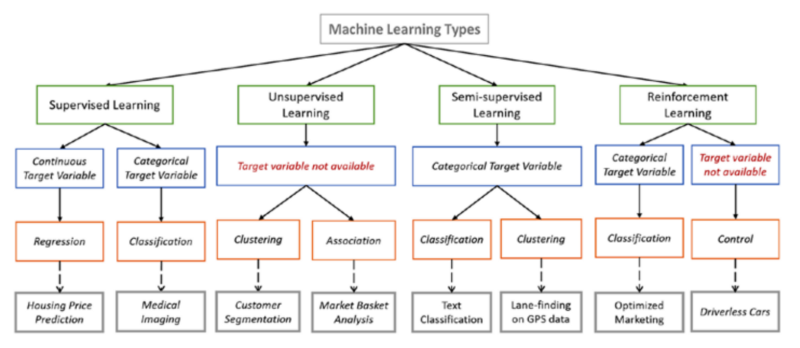
There are four types of machine learning (some might say three but here we will go with four the “more the merrier right!!!”).
- Supervised Learning: “The outcome or output for the given input is known before itself” and the machine must be able to map or assign the given input to the output. Multiple images of a cat, dog, orange, apple etc here the images are labelled. It is fed into the machine for training and the machine must identify the same. Just like a human child is shown a cat and told so, when it sees a completely different cat among others still identifies it as a cat, the same method is employed here.
Key points:
- Regression and classification problems are mainly solved here.
- Labelled data is used for training here.
- Popular Algorithms: Linear Regression, Support Vector Machines (SVM), Neural Networks, Decision Trees, Naive Bayes, Nearest Neighbor.
- It is mainly used in Predicting Modelling.
2. Unsupervised Learning: “The outcome or output for the given inputs is unknown”, here input data is given and the model is run on it. The image or the input given are grouped together here and insights on the inputs can be found here(which is the most of the real world data available). The main algorithms include Clustering algorithms( ) and learning algorithms.

Key points:
- It is used for Clustering problems(grouping), Anomaly Detection (in banks for unusual transactions) where there is a need for finding relationships among the data given.
- Unlabeled data is used in unsupervised learning.
- Popular Algorithms: k-means clustering, Association rule.
- It is mainly used in Descriptive Modelling.
3. Semi-supervised Learning: It is in-between that of Supervised and Unsupervised Learning. Where the combination is used to produce the desired results and it is the most important in real-world scenarios where all the data available are a combination of labelled and unlabeled data.
4. Reinforced Learning: The machine is exposed to an environment where it gets trained by trial and error method, here it is trained to make a much specific decision. The machine learns from past experience and tries to capture the best possible knowledge to make accurate decisions based on the feedback received.

Key points:
- Basic reinforcement is modelled as Markov Decision Process
- The most popular algorithms used here is Q-Learning, Deep Adversarial Networks.
- Its practical applications include computer playing board games such as chess and GO, Self-driving cars also use this learning.
To put the above in a nutshell view the image below from en.proft.me

I really liked your blog post.Much thanks again. Awesome.
ReplyDeleteMachine Learning Online Training In Hyderabad